


Microsoft Xbox One - One Size that Fits All Your Entertainment

It's been a long time since Microsoft released a new gaming console, but it isn't surprising that a new console was needed to match the needs of gamers and to bring a perfect rival to Sony's PlayStation and Nitendo's Wii consoles
"Microsoft unveiled the new console, called Xbox One. Featuring an all in one entertainment system that completely fills up anyone's living room desires"
Microsoft has unveiled the new Xbox, and it's called Xbox One. It's Microsoft's first new console in more than seven years. Yes, we've had many expectations for this console, especially since Sony and Nintendo have already taken their first steps in the next-gen landscape. Here's what you need to know that was announced at Microsoft's event in Redmond, Washington.
The Xbox One

The original Xbox debuted in the fall of 2005, which feels like a million years ago.. even if it's only seven and a half. It's high time for a new console, even if some tech pundits are questioning the value of gaming hardware platforms in the current age.
Design

The Xbox One is large, sleek, and black, and looks like a piece of AV equipment. The controller and Kinect unit are redesigned, too: the Kinect and Xbox One, in particular, sport sharp-angled, glossy-black boxy looks. As a set, the Xbox One really does feel like some elaborate piece of home theater gear...and considering its mission to knit entertainment together into a modern all-in-one package, that's clearly intentional. It also looks awfully big, compared with current-gen consoles and how they've slimmed down.
The name "Xbox One" suggests a reboot, a fresh start. Maybe from this day forward, Microsoft's connected living-room PC strategies will spring from the Xbox One. Or, it'll just a be a very good gaming console.

Home entertainment
Microsoft promises that this is a better-connected way of linking TV, games, and entertainment in one unit -- something the Xbox 360 already does, but will do more via commands like "Xbox, on." As was said during the initial presser, you're "going to have a relationship with your TV." The elevator pitch: take on a living room that has become "too complex," and make a system that knits games, TV, and entertainment.
So, how will that happen?
There are universal gestures such as grab-and-pan and swipe up; watching live TV will involve maximizing and minimizing the screen in a top corner. Live TV will be part of the Xbox One experience, via HDMI-in. Yes, cable TV looks like part of the package.
But we haven't seen, other than some picture-in-picture overlays, how exactly TV is piped in and more deeply interacted with...and who the partners are. Comcast was mentioned, but what other companies will contribute to letting the Xbox One hook in and become a true TV accessory? That was the challenge that daunted Google TV and the Wii U. Right now, it doesn't look like the Xbox One replaces your cable box or your DVR, even though it's large enough to be both.
The Xbox One does knit together new voice commands to do some PC-like stuff: you can order movie tickets, for instance, engage in Skype, or pull up fantasy sports stats while watching a game. The conversational, Siri-meets-Google Now-like voice commands hopefully will have clear menu representation on the console, as otherwise it could get confusing.
"It's an all-in-one entertainment console" is a pitch we've heard before, dating back to the PlayStation 3 and before that -- really, going back all the way to the 3DO. It hasn't always worked, but the Xbox One is better positioned because the Xbox 360's already pretty successful at being an excellent streaming-video device.
(Credit: Microsoft)
Specs

Under the hood, details so far include an eight-core processor and graphics made by AMD, 8GB of RAM, Blu-ray, USB 3.0, HDMI in/out, and a 500GB hard drive. Besides all of this, Microsoft is promising a new operating system fusing Xbox and Windows.
Xbox One architecture has "three operating systems in one": Xbox, a kernel of Windows (perhaps like Windows RT), and a multitasking interface. The idea seems to be that this console will be a multitasker at heart. Check out a head-to-head comparison with the PlayStation 4 specs known so far, however, and you can see that the distance between Sony and Microsoft, in terms of hardware, will be shorter than ever.
The Xbox One's Kinect.
 |  |
A new Kinect comes with the Xbox One, complete with improved accuracy. It has a 1080p camera, Skype connectivity, and understanding of rotational movement in a structure like a skeleton. Microsoft even claims the new Kinect can read your heartbeat. It can also recognize your controller, not just your hands -- suggesting uses that sound a little like the ones for PlayStation Move's wand.
The Xbox One controller
 |  |
New controller
The Xbox controller's gotten a revamp with an integrated battery, improved ergonomics, a better D-pad, and improved response triggers. It looks similar but has gotten a bunch of gamer-oriented tweaks.
SmartGlass
The tablet-based SmartGlass experience will center on Xbox One, and will work as before with a variety of phones and tablets. Baked-in Wi-Fi Direct on the Xbox One will allow Bluetooth-like direct communication between external devices, which could come in handy for other future peripherals, too. Second screens will be a major method of interacting with the Xbox One, but details were scarce at the Xbox event -- how will it be better than, and more profound than, SmartGlass as it currently exists?Xbox Live
Built on the existing service and usernames, the new Xbox Live promises 300,000 servers for Xbox One, a whopping number. Matchmaking services will work while you're doing other tasks like watching movies or Web browsing, and bigger, more quickly connecting matches are promised, too. Microsoft has discussed some cloud services on the Xbox One that seem promising: user-based cloud game saves, uploaded game recording, and even the potential for cloud-processing-enhanced games. How that will play out isn't clear.Games
Microsoft plans eight new franchises for the Xbox One in the first year, a hopeful sign for a platform that's become too sequel-dependent. Of course, Forza 5 was shown off, but a new game called Quantum Break from the developers of Alan Wake looks like the sort of game we're more used to seeing from PlayStation, with a big-studio design and cinematic feel. But there is some bad news: like the PlayStation 4, the Xbox One isn't backward-compatible with Xbox 360 games.TV on Xbox
"Xbox is going to be the next water cooler." That was said during the event to suggest the Xbox One's role as a social-TV platform. To that end, it sounds like Microsoft is developing TV shows and original programming for the Xbox One, making a greater leap into Netflix-like original programming. Steven Spielberg announced a new TV series based on Halo, and the NFL demonstrated some level of interaction with fantasy stats and Skyping with NFL broadcasts.Availability
The Xbox One will be available "later this year," so that means 2013 after all. Price and a specific date will have to wait...after all, E3 is just weeks away. In short, there are still several things about the Xbox One we don't know...and would like to.Early Availability notification signups:
Microsoft is also accepting early notification signups for the availability of Xbox One.Now its time to know what you all think. You can leave a review over the poll (till its open) and also give us review over the new Xbox One in comments
Will Xbox One match the Entertainment needs of its audience?
Love Windows Live Messenger? Here's how you can bring it back

Microsoft recently killed off Windows Live Messenger in favor of Skype, leaving many of us without years' worth of chat logs or the familiarity that MSN brings. Skype, while good, doesn't have the same stability as MSN and adds a lot of unwanted clutter. Microsoft have blocked MSN from working for many users, but some new software from a Microsoft MVP allows you to bring back Messenger in a few simple steps.
Messenger Reviver 2 is a free piece of software that installs, repairs and modifies Windows Live Messenger '08, '09, '11 and '12 to allow them to sign in, despite Microsoft's block. Currently, when you access Messenger you're prompted to "install the newer version in order to continue," but Reviver installs a patch that allows WLM to continue to be used.

To bypass this message, download Messenger Reviver 2. The programme makes changes to your computer, so grant it the relevant levels of access. (A zipped version of the program is also available to bypass security software blocking). The software runs on Windows XP through to Windows 8 and .NET framework version 2.0 or higher, though .NET 3.5 or 4 is recommended.
Once downloaded, a window will pop-up that looks like this:
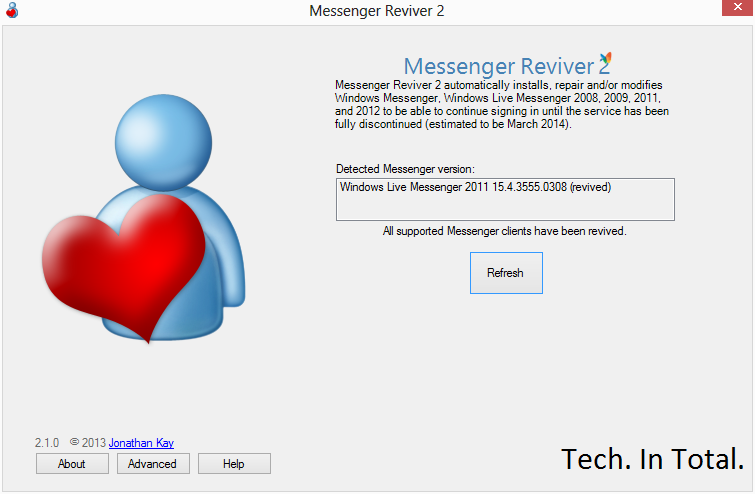
Click "Start" and the program will automatically modify Messenger and restart it. If Windows Live Essentials is not installed, Reviver will offer the option to install the software. If Essentials is installed, but Skype has removed it, Reviver offers the ability to re-install it:

If you no longer have Windows Live Messenger on your system don't worry, we've got you covered.
Download: Windows Live Messenger 2012 (offline installer)
View: More information can be found here
The Google has gone 1K times Better, Switching from Strings to Things

The Google Search of the future is here. Now. Today. The long-talked-about semantic web — Google prefers “Knowledge Graph” — is rolling out across all Google Search tools, and our most fundamental online task may never be the same again.
Starting today, a vast portion of Google Search results will work with you to intuit what you really meant by that search entry. Type in an ambiguous query like “Kings” (which could mean royalty, a sports team or a now-cancelled TV show), and a new window will appear on the right side of your result literally asking you which entity you meant. Click on one of those options and your results will be filtered for that search entity.
To understand the gravity of this change, you need to know about the fundamental changes going on behind the scenes at Google Search. As we outlined in our report earlier this year, Google is switching from simple keyword recognition to the identification of entities, nodes and relationships. In this world, “New York” is not simply the combination of two keywords that can be recognized. It’s understood by Google as a state in the U.S. surrounded by other states, the Atlantic Ocean and with a whole bunch of other, relevant attributes.
As Ben Gomes, Google Fellow, put it, Google is essentially switching “from strings to things.”
To build this world of things, Google is tapping a variety of knowledge databases, including Freebase, which it bought in 2010, Wikipedia, Google Local, Google Maps and Google Shopping. Currently, Google’s Knowledge Graph has over 500 million people, places and things and those things have at least 3.5 billion attributes.
That’s a lot of things. According to Google, search users will see these new knowledge graph results at least as often as they see Google Maps in results. In fact, this update will have a greater initial impact than the updates that brought Google Images, videos, news and books, combined. It’s big and it’s probably going to be everywhere.
Summaries of Good Stuff
In addition to the window which will help users find the right “thing,” Google will also surface summaries for things, which, again, will try to be somewhat comprehensive by tapping into the various databases of knowledge. A search for Frank Lloyd Wright, for instance, will return a brief summary, photos of Wright, images of his famous projects and perhaps, most interestingly, related “things.” People who search for Wright are also looking for other notable architects. It’s a feature that may remind users of Amazon’s penchant for delivering “people who liked this book also bought or searched for this one” results.
Gomes said that the search results are tailored to deliver information that best relates to the initial search result. So the details delivered about a female astronaut will likely outline her space travel record, because that’s what people who search for her are, according to Google, most interested in.

How the Knowledge Graph Works.
Since this is a knowledge graph (“Web” might be a better word), the results are designed to help you dig more deeply into related topics. Google showed us how someone might start by searching for a local amusement park, find an interesting rollercoaster as one of the “things” that relates to the park and end up digging in on details about that coaster and other similar rides. It’s a “skeleton of knowledge that allows you to explore information on the web,” said Gomes.
There is the potential, Gomes added, of serendipitous discovery. The more you dig into things, the more things you learn about.
Of course, not every “thing” is the right thing. Wikipedia is, for example, a community-sourced encyclopedia that is known for both its breadth and depth of information and the occasional whoppers of misinformation it stores. Google’s Knowledge Graph includes an error reporting system. When users find misinformation, Google will share it with the source and the knowledge graph will get just a little bit smarter
For now, though, the Knowledge Graph is not getting any smarter about you. If you search for an ambiguous topic and then guide Google Search to the more defined set of results, the same query later will not go directly to that filtered information — at least not yet. “We don’t have anything to announce for personalization,” said Gomes.
The Competition
Google’s chief search competitor, Microsoft Bing, also has millions of entities, but it’s not aiming for the purely semantic model of search results. Instead, Bing execs told Mashable that it’s focusing, in part, on much smaller set of segments that its users typically search on (i.e.: restaurants, hotels, movies) and trying to surface relevant information regarding those segments. A search result for hotels, for example, might include reservation tools. And while Google search now blends in Google+ results, Bing’s latest instantiation has moved social information to the right side of its search results page
It’s unclear for now how the Google Knowledge Graph, which pushes aside keyword results in favor of relationships and artificial intelligence, impacts all the Search Engine Optimization (SEO) many web sites have done to push their search rank ever higher. Also unknown is how, if at all, Google’s sea change will impact Google+. Gomes revealed that some Google+ changes were coming “independent of this” update and that Google will be talking about them separately.
Eventually, Google’s search will get smarter and will stop asking for your help to understand your query and start answering complex questions like “What is the coldest lake in the world in July?” It doesn’t matter why you want to know that, just that, someday, the right answer will be a click away on Google Search.
Google’s Knowledge Graph will roll out across the U.S. (and on all Google platforms: desktop, mobile, tablet) in the coming days. Eventually, it will go global. Give it a try and let us know what you think of the brand new Google Search in the comments.
Hackers using Skype to attack Windows PCs

Free internet-calling service Skype is being used by hackers to distribute a 'worm' that infects users Windows PCs.
On clicking an instant message saying "lol is this your new profile pic?" users are unwittingly downloading a file containing a Trojan horse malware file.
This opens a backdoor allowing hackers to hijack infected PCs and recruit them into a "botnet army".
Users can be locked out of their machines and held to ransom, the BBC reports.
According to the report, Skype said in a statement that they 'are aware of this malicious activity and are working quickly to mitigate its impact.'
"We strongly recommend upgrading to the newest Skype version and applying updated security features on your computer," the firm said in a statement.
"Additionally, following links - even when from your contacts - that look strange or are unexpected is not advisable," it added.
Google Street View Is Now Available on the Google Maps Webapp

Google has added the Street View feature to its Google Maps webapp, giving the already robust mapping system a nice on the ground viewpoint for wherever you're going.
To access Street View, type in the address you're looking for into Google Maps on your mobile browser, and click the person icon in the bottom right corner. You'll drop down into the traditional Street View and you can swipe to look around. If you've been missing the Street View feature on iOS 6, this is nice to have around to get a better idea of where you're going, and it makes the Google Maps webapp that much more useful.
Google Maps
Intel-powered ultrabooks a major flop: Research

Ultrabooks -- those sleek, lightweight laptop computers that were supposed to fire up PC sales -- are not catching on with consumers, a new survey shows.
The research firm IHS iSuppli on Monday slashed its forecast in half for the ultrabooks, saying high prices and ineffective marketing have culminated in a failure to lure buyers away from other hot-selling mobile gadgets.
The survey showed 10.3 million ultrabooks will ship worldwide in 2012, down from the previous forecast issued earlier this year of 22 million units. More than half of the shipments for the year are expected in the fourth quarter.
For next year, iSuppli cut its forecast to 44 million from a prior estimate of 61 million.
"So far, the PC industry has failed to create the kind of buzz and excitement among consumers that is required to propel ultrabooks into the mainstream," IHS analyst Craig Stice said.

"This is especially a problem amid all the hype surrounding media tablets and smartphones. When combined with other factors, including prohibitively high pricing, this means that ultrabook sales will not meet expectations in 2012."
The latest report said that to fire up sales, prices need to come down from the $1,000 range to around $600.
It said if ultrabooks using the new Windows 8 operating system come close to the $600-$700 range next year, while adding in an new features such as touchscreen, a good chance exists for strong sales in 2013. Otherwise, consumers may opt for other devices.
"With the economy languishing, ultrabook sellers may have trouble finding buyers at the current pricing, especially with fierce competition from new mobile computing gadgets such as the iPhone 5, Kindle Fire HD and forthcoming Microsoft Surface" tablet, Stice said.
IHS said that despite the challenges, ultrabook sales will rise to 95 million by 2016.
The ultrabook is a term for a lightweight notebook computer coined by Intel. But ISH said Intel's "stringent" definitions are prompting some manufacturers to shun the term and call the PCs, "ultrathins," instead.
Source: The Times Of India
Popular Posts
-
 It's been about three years since Microsoft unveiled a new version of Office, and particularly with Windows 8 just months away from ...
-
 There's general agreement that Sony stumbled out of the gate with the PlayStation 3. Months of intense hype were followed by a la...
-
 Latest Windows Phone 8 rumor suggests that current Windows Phone devices will receive the update Microsoft has yet to come forward wi...
-
Microsoft is holding an invitation-only press event in San Francisco today at which it is expected to debut the next version of its...
-
 Gaming & Gadgets Microsoft kick-started the "next-generation" of gaming on November 22, 2005, when the company release...

